
DTF transfers vs screen printing is more than a preference—it's a decision that shapes your brand's look, cost, speed to market, and how customers perceive your commitment to quality. DTF transfers benefits include detailed artwork, broad fabric compatibility, and on-demand production, making it appealing for testing new designs and iterating collections without large upfront investments. Screen printing vs heat transfer offers bold color blocks, while the durability of DTF vs screen printing can vary with inks and fabrics, and it remains cost-efficient for bulk runs. When you weigh the cost comparison DTF vs screen printing, order size, production timeline, and fabric type can tilt the decision, influencing margins, inventory risk, and time to market. This guide highlights how to balance detail, feel, and margins to arrive at the best method for custom apparel for your brand.
To frame this choice in broader terms, you can compare direct-to-film options alongside traditional silk-screen methods, considering sustainability, waste, and supplier reliability. Viewed through an on-demand decoration lens, digital transfer techniques map to fast turnarounds and limited editions, while screen printing aligns with bulk production and uniform finishes, with scalability baked in. For brands chasing rapid drops and customization, digital-transfer approaches enable flexibility without costly tooling; for those prioritizing longevity and cost per unit at scale, classic stencil-based printing remains compelling, especially where brand consistency matters. Understanding these related terms helps you build a cohesive product strategy as you plan catalogs, seasonal drops, and experiments across channels and markets. By mapping these terms to your product roadmap, you can reduce risk and tailor production to market needs.
DTF transfers vs screen printing: which method is right for your brand?
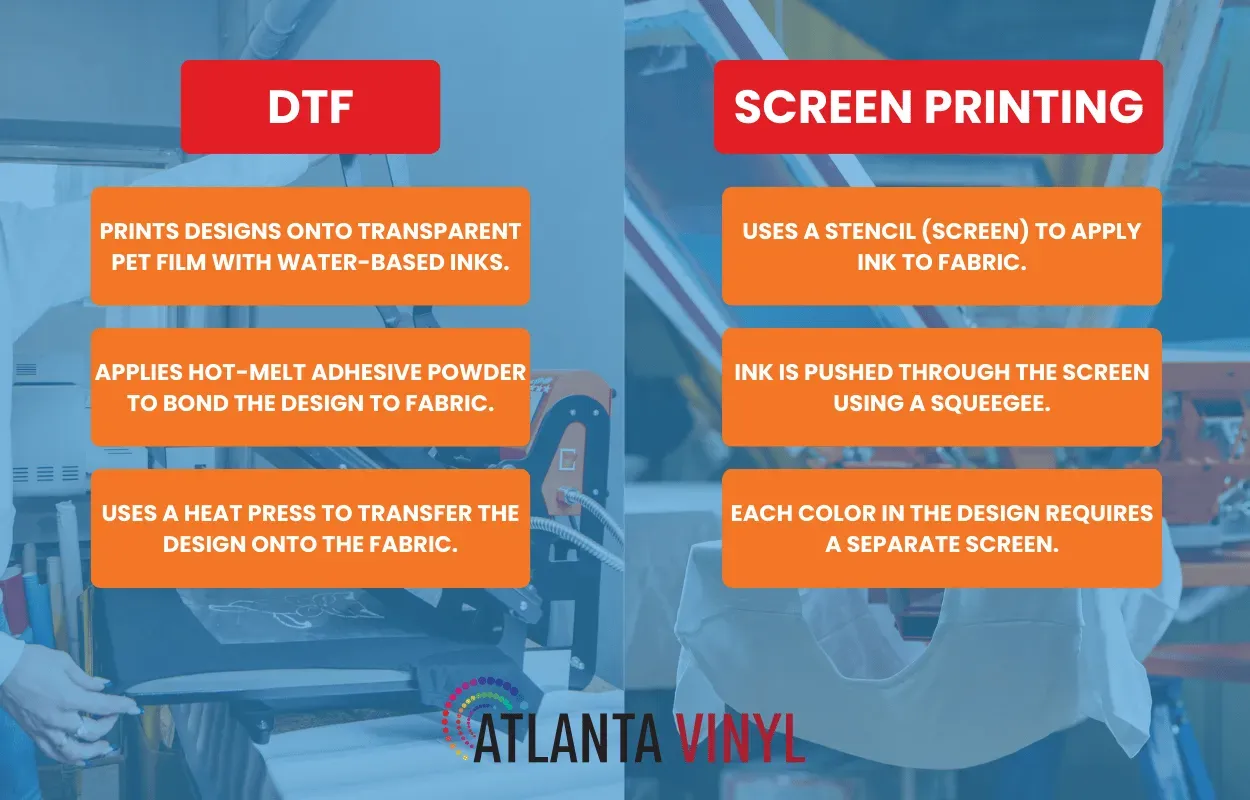
Choosing between DTF transfers and screen printing starts with understanding how each method works and the impact on your brand. DTF transfers deliver artwork printed on film with a heat-activated adhesive, then transferred to fabric for a vivid, highly detailed result. Screen printing pushes ink through stencils onto fabric, delivering bold color blocks with a distinct texture. For many brands, the comparison goes beyond visuals to consider speed, flexibility, and the ability to offer frequent drops without sacrificing consistency.
As you weigh options, it’s helpful to think about your product lineup, margins, and go-to-market rhythm. Some brands prioritize rapid testing and small runs, where DTF transfers shine, while others aim for high-volume staple items where screen printing often proves more cost-efficient over time. This guide breaks down the strengths and trade-offs of each method, helping you decide which aligns with your goals, budgets, and brand storytelling.
DTF transfers benefits: when this method shines
DTF transfers benefits include the ability to reproduce detailed artwork, gradients, and photographic imagery with accuracy, even on diverse fabric types. This makes DTF ideal for limited editions, seasonal drops, and designs that rely on fine lines or subtle color shifts. The transfer process also simplifies experiments with new art without committing to large production runs.
Another key advantage is flexibility. DTF supports small batches and on-demand production, enabling brands to test concepts, iterate quickly, and reduce inventory risk. For brands exploring a broader range of SKUs, DTF transfers benefits can help maintain variety without tying up capital in screens or large-scale print runs.
Durability and feel: durability of DTF vs screen printing
Durability considerations vary with ink chemistry, curing, and fabric, but both methods can achieve long-lasting results when applied correctly. DTF inks are typically soft to the touch on many fabrics, and with proper finishing, they hold up well on a wide range of blends and dark fabrics. The texture may feel lighter on lighter fabrics, contributing to a comfortable hand for everyday wear.
Screen printing, particularly on cotton and similar blends, is renowned for its robust finish and wash resistance, often outlasting other methods in bulk runs. The durability of DTF vs screen printing can tilt in favor of screen printing at scale, especially when you’re producing hundreds or thousands of identical items with solid color blocks and standard fabrics.
Cost considerations and the cost comparison DTF vs screen printing
Cost considerations for each method hinge on order size, artwork complexity, and fabric. DTF often has lower setup costs, making it attractive for small runs, on-demand production, and experimentation without the need for screens. However, the per-unit cost of a transfer can be higher than a bulk screen print for large volumes, so total cost must be evaluated in the context of your anticipated run size.
The cost comparison DTF vs screen printing becomes more favorable for screen printing as order quantity grows, due to economies of scale and the efficiency of continuous runs. When budgeting, brands should factor in not only the unit price but also setup time, potential reprints for color adjustments, and the overall calendar for drops. This holistic view helps you choose a method that balances cash flow with launch velocity.
Fabric compatibility and color strategy for brand consistency
Fabric compatibility is a core consideration in any print decision. DTF transfers provide broad fabric coverage, including cotton, blends, poly blends, and some performance fabrics, with less need for pretreatment. This makes DTF appealing for diverse product lines and mixed-material collections where color fidelity matters across fabrics.
A careful color strategy is essential to maintain brand consistency across methods. DTF can reproduce photorealistic imagery and gradients on both light and dark fabrics, while screen printing excels at bold, saturated blocks of color with crisp edges. For brands that emphasize photography-driven artwork or multi-tone design language, fine-tuning color management ensures that each drop looks cohesive on every fabric choice.
Best method for custom apparel: choosing a hybrid or single approach
Best method for custom apparel often isn’t a single-answer question. A hybrid approach—using screen printing for core staples and DTF transfers for limited editions, seasonal variants, or on-demand drops—can deliver the best balance of durability, cost, and flexibility. This strategy supports a consistent baseline product while keeping room for experimentation and rapid market testing.
To implement effectively, start with a clear design roadmap and forecast the expected mix of SKUs. Consider the questions around order size, color complexity, and fabric variety, then map each design to the most suitable method. By aligning production decisions with your brand strategy and go-to-market cadence, you can optimize quality, margins, and speed to market, while still delivering on your vision for custom apparel.
Frequently Asked Questions
DTF transfers vs screen printing: how does durability compare across fabrics and wash cycles?
Durability hinges on ink quality, fabric, and cure time. Screen printing is renowned for long-lasting prints on cotton when properly pretreated, while DTF transfers maintain strong color fidelity on a wide range of fabrics, including blends and darks. With proper heat, pressure, and wash settings, both methods can withstand many cycles, though screen printing often delivers the most durable results on 100% cotton.
DTF transfers vs screen printing: what is the cost comparison for small runs and custom orders?
DTF typically has lower setup costs, making it cost-effective for small runs and on-demand production. Screen printing becomes more economical per unit as order quantities rise due to fixed screen setup. Consider transfer material costs, ink usage, and the design’s complexity when calculating total cost of ownership.
DTF transfers benefits: what makes DTF transfers benefits stand out for intricate designs compared to screen printing?
DTF transfers benefits include faithful reproduction of gradients, fine details, and photo-realistic imagery on many fabrics. This gives brands flexibility for limited editions and complex artwork without creating screens. For simple bold designs, screen printing may be more cost-efficient at scale.
Best method for custom apparel: should a brand choose DTF transfers vs screen printing for its tees?
The best method for custom apparel depends on design, volume, and hand feel. Use DTF transfers for intricate art, rapid drops, and on diverse fabrics; use screen printing for core items, bold color blocks, and high-volume runs. Many brands blend both methods, reserving DTF for limited editions and screen printing for staples.
Screen printing vs heat transfer: how does DTF transfers fit into this comparison when considering color richness and feel?
Screen printing vs heat transfer is a common frame, but DTF transfers offer extra flexibility. DTF can deliver detailed gradients and photo-like imagery with a softer hand on many fabrics, while screen printing excels with solid color blocks and a robust feel on cotton. In short, DTF bridges some gaps between these methods, depending on artwork and material.
Which approach works best for a hybrid strategy: DTF transfers vs screen printing for core items and limited editions in a custom apparel lineup?
A hybrid approach often delivers the best balance: screen printing for core items and high-volume runs, DTF transfers for limited editions and complex artwork. This aligns with factors like design complexity, fabric variety, seasonality, and sustainability goals. Plan designs and inventory to leverage each method's strengths while keeping costs and turnaround reasonable.
| Aspect | DTF transfers | Screen printing |
|---|---|---|
| How it works: overview | Prints on a clear film with adhesive, then heat pressed to fabric | Ink is pushed through a mesh stencil directly onto fabric |
| Fabric compatibility | Wide range including cotton, blends, polyester, and dark/ textured fabrics | Versatile across fabrics but may require pretreatment or special inks for certain materials |
| Color and detail | Excellent detail, gradients, and photo-like imagery | Bold colors, crisp edges; extremely fine detail can be challenging without extra colors |
| Feel/hand | Usually softer to the touch, especially on dark fabrics with proper layering | Can feel more substantial on heavier fabrics |
| Setup & minimums | Lower setup costs; friendly to small runs and on-demand production | Higher setup costs; cost-efficient at higher volumes |
| Turnaround & flexibility | Fast for small batches; no screens required per color | Screens per color add setup time; advantageous at scale |
| Durability | Strong color fidelity and durability across diverse fabrics when cured properly | Durable inks on cotton; proven performance in high-volume runs |
| Best-use scenarios | Small runs, detailed artwork, on-demand variations, and rapid testing | High-volume launches, core staple designs, and bold color blocks |
Summary
DTF transfers vs screen printing are two distinct approaches to apparel printing, each shaping brand identity, production efficiency, and costs in different ways. When deciding between them, consider order size, design complexity, fabric types, and your overall brand strategy. DTF transfers excel at detailed artwork, photo-like imagery, and on-demand or limited-edition drops across a wide range of fabrics, making them ideal for experiments and small runs. Screen printing shines in durability and cost efficiency at scale, particularly for bold color blocks and high-volume staples. A practical path is a hybrid approach: use screen printing for core items and reserve DTF transfers for seasonal variants, experimental runs, or limited editions. By evaluating factors such as design complexity, fabric compatibility, sustainability goals, and supplier capabilities, you can craft a printing plan that balances quality, speed, and margins while supporting your brand’s growth and customer expectations.